Key takeaways
- Compare the best meat tenderizers for steaks and chicken: needle tools and dual-sided mallets, with blade counts, sizes, and care explained.
- Top Pick: Jaccard 200348 48-Blade Meat Tenderizer, White
- Runner-up: KitchenAid Gourmet Multi Sided Meat Tenderizer, Black
- Also consider: OXO Good Grips Meat Tenderizer
The best meat tenderizer for most kitchens is the Jaccard 200348 48-Blade Meat Tenderizer in White, a needle tenderizer with 48 stainless steel blades that cut connective tissue and open channels for marinade without flattening the meat. For pounding cutlets flat, the KitchenAid Gourmet Multi Sided Meat Tenderizer is the pick: a dual-sided aluminum mallet with a ridged side for tenderizing and a flat side for flattening. The OXO Good Grips Meat Tenderizer is the most comfortable mallet here, with a soft silicone grip, while the Norpro Meat Tenderizer is the light, budget needle tool with 24 spring-loaded prongs. The Jaccard 200348T in Yellow is the same 48-blade tool as the White pick in a color-coded finish.
This guide covers meat tenderizers only: needle tools that pierce meat with rows of blades, and mallets that pound meat flat with a textured or smooth face. A meat grinder is a different tool: it minces meat into ground meat, while a tenderizer keeps the cut whole and only softens it. Every pick below lists its published specifications, so you can compare blade count, size, and materials before choosing.
As an Amazon Associate, we earn from qualifying purchases.
Table of Contents
- Meat Tenderizers vs Meat Grinders
- How to Choose a Meat Tenderizer
- Jaccard 200348 48-Blade Meat Tenderizer, White
- KitchenAid Gourmet Multi Sided Meat Tenderizer, Black
- OXO Good Grips Meat Tenderizer
- Norpro Meat Tenderizer
- Jaccard 200348T 48-Blade Meat Tenderizer, Yellow
- FAQ
- Conclusion
- Product and ASIN Reference
Meat Tenderizers vs Meat Grinders
A meat tenderizer and a meat grinder solve different problems, and buying one when you need the other is the most common mistake in this category. A tenderizer works on a whole cut: it softens the meat, breaks down tough connective tissue, and opens channels that let marinade soak in, while the steak, chop, or chicken breast keeps its shape. A grinder minces meat into ground meat for burgers, sausages, and meatballs. Once meat is ground, it cannot go back to being a steak.
A needle tenderizer is a handheld press with rows of thin blades that pierce the surface in one push. A mallet is a hammer with a textured face on one side and a flat face on the other: the textured side breaks fibers, and the flat side pounds the cut to an even thickness. A grinder, by contrast, is a machine or a stand-mixer attachment with a hopper, an auger, and a die plate. If your goal is a tender steak that still looks like a steak, you need a tenderizer, not a grinder.
How to Choose a Meat Tenderizer
Start with type. A needle tenderizer pierces the meat without changing its shape, which suits steaks, roasts, and thick chops where you want marinade to penetrate. A mallet pounds the meat thinner, which suits chicken breasts, veal cutlets, and pork chops that need to cook evenly at a uniform thickness. If you mostly flatten cutlets, a mallet is the faster tool; if you mostly marinate steaks, a needle tenderizer is the right one.
Blade and prong count decides how many channels each press makes: 48 blades cover a steak in one press, while 24 prongs need a second press to cover the same area. A 48-blade tool works faster on large cuts, while a 24-prong tool suits smaller pieces and lighter work. A mallet has no blade count to compare: instead, check whether the head has both a textured side and a flat side, because the two faces do different jobs.
Size and weight come next. A needle tenderizer is a compact press that stores in a drawer, and its footprint decides how much of the cut each press covers. A mallet is longer and heavier, and its weight does much of the work: a heavier head pounds with less effort, while a lighter head gives more control on thin cutlets.
Materials and care finish the choice. Stainless steel blades resist rust and hold an edge, while an aluminum mallet head is light and strong. Handles are plastic, silicone, or rubber, and a soft, non-slip grip matters, because you swing a mallet with one hand and press a needle tool down firmly. Care varies: some tenderizers are listed as dishwasher safe and others for hand washing, so check the care line before you buy, and keep blades and prongs away from fingers during use and cleaning.
Jaccard 200348 48-Blade Meat Tenderizer, White
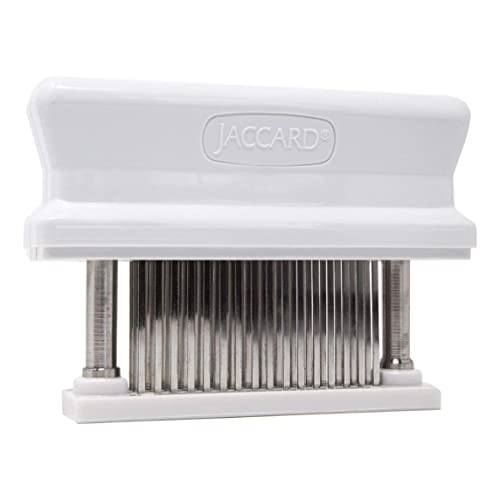
The Jaccard 200348 is the best all-around pick because it is the original 48-blade needle tenderizer. Forty-eight razor-sharp stainless steel blades pierce the meat in a single press, cutting through connective tissue and creating tiny channels that let marinades soak in faster. The white ABS plastic body keeps the tool light in the hand at 12 ounces, and the unit disassembles for cleaning, so the blades can be washed properly after use.
The tenderizer measures 4 inches by 1.5 inches by 5.75 inches, and the model number is 200348, first available in March 2004. The listing states that the blades work on beef, pork, veal, chicken, venison, and fowl, including inexpensive tough cuts. One guide lists the size as 5-5/8 by 4-1/8 inches rather than the listing dimensions, so treat the dimensions as approximate.
This tenderizer suits anyone who marinates steaks and roasts and wants the cut to keep its shape. Its limit is thin meat: 48 long blades can pass through a very thin cutlet, so it is not the pick for flattening.
Specs:
- Type: needle tenderizer, 48 blades
- Blades: 48 stainless steel razor-sharp blades
- Body: white ABS plastic
- Size: 4 by 1.5 by 5.75 inches
- Weight: 12 ounces
- Care: disassembles for cleaning
- Model: 200348
- UPC: 885437046216
- First available: March 10, 2004
- ASIN: B001347JK6
KitchenAid Gourmet Multi Sided Meat Tenderizer, Black
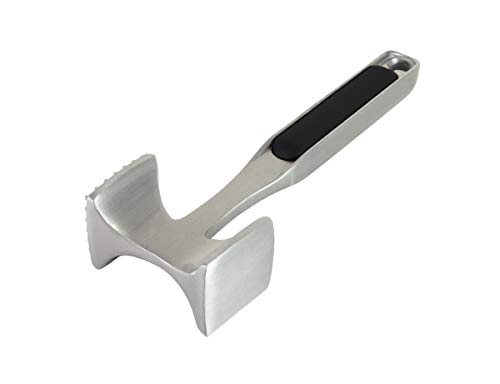
The KitchenAid Gourmet Multi Sided Meat Tenderizer is the pick for pounding cutlets flat with a strong, simple mallet. One side of the aluminum head has rows of raised points that tear connective tissue as you pound, and the opposite side is flat for pounding meat to a uniform thickness. The ergonomic handle has a built-in hang hole, so the mallet stores on a hook as well as in a drawer.
The mallet measures 1.97 inches by 3.35 inches by 9.45 inches and weighs 10.6 ounces, so the head has enough heft to do the work without tiring the wrist. The manufacturer is Lifetime Brands Inc, the model number is KO119OHOBA, and the listing carries UPC 024131404926, first available in March 2019. The maker lists hand washing, and the tool is not dishwasher safe. Beyond meat, the listing notes the mallet can crack nuts, shellfish, peppercorns, and hard candy.
This mallet suits anyone who flattens chicken breasts and pork chops for even cooking and wants a dual-sided tool for both tenderizing and pounding. Its limit is that it changes the shape of the meat: if you want a thick steak to stay thick, a needle tenderizer is the better choice.
Specs:
- Type: mallet tenderizer, dual-sided
- Head: aluminum, textured side and flat side
- Size: 1.97 by 3.35 by 9.45 inches
- Weight: 10.6 ounces
- Handle: ergonomic with hang hole
- Care: hand wash; not dishwasher safe
- Manufacturer: Lifetime Brands Inc
- Model: KO119OHOBA
- UPC: 024131404926
- First available: March 26, 2019
- ASIN: B07Q2WVG1Z
OXO Good Grips Meat Tenderizer

The OXO Good Grips Meat Tenderizer is the pick for comfortable everyday pounding. The two-sided mallet has a pyramid-textured steel side for tenderizing and a smooth side for flattening, and the soft silicone handle gives a non-slip grip that stays comfortable through repeated pounding.
The model number is 11285000, with UPC 719812000770, first available in January 2020. The head is smaller than the KitchenAid mallet above, so it suits single cutlets rather than large roasts. The listing showed no featured offers at the time this guide was researched, so check availability before ordering.
This tenderizer suits anyone who wants a comfortable-grip mallet for everyday chicken and steak prep. Its limit is head size: for bulky cuts, a larger mallet covers more area per strike. Care needs a note: some listings describe the tool as dishwasher safe, while a deal listing advises against machine washing, so hand washing is the safer choice.
Specs:
- Type: mallet tenderizer, two-sided
- Head: aluminum with pyramid-textured side and smooth side
- Handle: soft silicone non-slip grip
- Care: hand wash recommended; some listings list dishwasher safe
- Model: 11285000
- UPC: 719812000770
- First available: January 14, 2020
- ASIN: B083VVWCSK
Norpro Meat Tenderizer

The Norpro Meat Tenderizer is the light, budget needle tool in this guide, and the pick for small jobs. Twenty-four stainless steel prongs break down tough meat fibers and connective tissue, and a spring-action mechanism controls the press so each push is even and measured. At 4 ounces, it is the lightest tenderizer here.
The model number is 7032, with UPC 028901070328, first available in July 2004. The listing states the tool improves the texture and taste of poultry, fish, and beef, and that the prongs help marinade absorb faster into the meat. The listing dimensions field shows 2 by 1.5 by 1.2 inches, which appears to describe the head only, while the description and retailer listings give the full tool as 7.5 by 2 by 2 inches.
This tenderizer suits anyone who wants a simple needle tool for occasional use on poultry, fish, and smaller cuts, and it is the only spring-action pick here. Its limits are the plastic handle, which one guide notes is less durable than metal, and cleaning: the spring mechanism makes hand washing fiddly, so rinse the prongs promptly after use.
Specs:
- Type: needle tenderizer, 24 prongs, spring-action
- Prongs: 24 stainless steel
- Size: 7.5 by 2 by 2 inches
- Weight: 4 ounces
- Handle: plastic
- Care: hand wash; spring mechanism needs prompt rinsing
- Model: 7032
- UPC: 028901070328
- First available: July 19, 2004
- ASIN: B00004UE7Y
Jaccard 200348T 48-Blade Meat Tenderizer, Yellow

The Jaccard 200348T in Yellow is the same 48-blade tool as the White pick above, in a color-coded finish. It has the same 48 razor-sharp stainless steel blades, the same ABS plastic body, and the same press-down action. The difference is the color: Jaccard sells this model in a color-coded family, so a kitchen can assign one color per meat type and keep tools separate.
The model number is 200348Y, with UPC 753392300103. The tracker record for this listing goes back to July 2020, and a price tracker showed a current offer in mid-November 2026, though one tracker page had not been updated for nine months, so check availability before ordering. This Yellow model and the White model above are separate listings, so they are listed as two distinct picks.
This tenderizer suits anyone who already trusts the 48-blade design and wants a second tool in a distinct color, or a kitchen that separates tools by meat type. Its limit is the same as the White pick: it pierces rather than flattens, so it is not the tool for thin cutlets.
Specs:
- Type: needle tenderizer, 48 blades
- Blades: 48 stainless steel razor-sharp blades
- Body: ABS plastic
- Color: yellow, color-coded family
- Model: 200348Y
- UPC: 753392300103
- ASIN: B08CQ333RV
FAQ
What is the best meat tenderizer for most people?
The Jaccard 200348 48-Blade Meat Tenderizer in White, because its 48 stainless steel blades cut connective tissue and open marinade channels in a single press without flattening the meat. If you mainly flatten chicken breasts and cutlets, the KitchenAid Gourmet mallet is the better choice.
Is a meat tenderizer the same as a meat grinder?
No. A meat tenderizer works on a whole cut: it softens the meat and opens channels for marinade while the steak, chop, or chicken breast keeps its shape. A meat grinder minces meat into ground meat for burgers and sausages, and ground meat cannot go back to being a steak.
Should I choose a needle tenderizer or a mallet?
Choose a needle tenderizer when you want marinade to penetrate a thick cut without changing its shape, as with steaks and roasts. Choose a mallet when you want to flatten a cut to an even thickness, as with chicken breasts and veal cutlets.
Can I use a meat tenderizer on chicken breasts?
Yes. A mallet flattens chicken breasts to an even thickness so they cook evenly, and a needle tenderizer opens channels that help marinade soak in. Use a clean cutting board for raw chicken, wash the tool promptly after use, and keep blades and prongs away from fingers.
Conclusion
The right meat tenderizer depends on whether you want to pierce or pound. The Jaccard 200348 in White is the best all-around choice for marinating steaks and roasts, with 48 stainless steel blades and a light ABS body. The KitchenAid Gourmet mallet is the pick for flattening cutlets, the OXO Good Grips mallet is the pick for comfortable everyday pounding, and the Norpro 24-prong tool is the light, budget needle pick for small jobs. The Jaccard 200348T in Yellow is the same 48-blade tool in a color-coded finish for kitchens that separate tools by meat type. Remember that a tenderizer softens a whole cut while a grinder minces meat, so pick the type that matches how you cook.